The world truly belongs to God, for his fingerprints are all over it

So over the last few days, I’ve just been writing out all the ideas I’ve had in my head. I figure it’s good practice! You probably noticed I have a bunch of recurring metaphors: inner fire, scale and patterns, big and small, infinity.

Why these motifs? When I was little, in the room I slept in at my grandparents’ house, there was a motivational poster on the wall. It said “The world truly belongs to God, for his fingerprints are all over it.” The picture in the middle was a mountain range, maybe the Himalayas. The idea is that, if you shift your perspective enough, the ridges of your fingerprints might look a lot like mountains. I pictured a gigantic hand coming down and impressing itself on the Earth when it was young and malleable, like leaving your handprint in play-doh. The idea of scale has fascinated me ever since! If I have religion or spirituality, it’s somewhere in here.

One of my friends from college, a geology major, said that he was studying “roughness” for his final project. Interestingly enough, the concept of roughness is entirely dependent on the scale you’re looking at! The roughness of an enormous cliff, if you take the whole cliff face as your frame, can be the same relative to a smooth surface examined up close. I love this idea still, and I wedded it with my favorite hobby of rock climbing to write about it in “Bits and Pieces.”

I tried looking for that poster, but unfortunately only came up with one billion shitty fake-motivational poster memes. If anyone finds it, let me know! I want to link it here. In the meantime, I thought I’d offer a little explanation so my posts wouldn’t come off as too obscure. =]

Posted in All posts | 1 Comment

The Perma-Stoke

As the years have come and gone, imparting me with new knowledge and experiences, my life’s goal has become increasingly clear: to achieve the elusive perma-stoke.

It’s self explanatory. To be perma-stoked is to be stoked as hell, permanently. Take care to distinguish it from the normal “stoke,” a fleeting, excited euphoria. The noun form of “stoke” is in fact its own entity—it is the set-up, the anticipation which builds to bursting point, the supreme satisfaction of being in the stoke itself, and the eventual depleting of this fiery kinetic energy. The casual stoke is a process, a mindset with a discrete beginning and end.

The perma-stoke is more subtle. It is wily, traitorous, and nigh-unattainable. If the normal stoke is a roaring bonfire, which blazes fiercely but dies as it consumes its fuel, then the coals of the perma-stoke are always lit. The pilot light is on, and one may activate the perma-stoke in an act of willful pyrogenesis. Yet it must be maintained; impurities in the fuel of your life, clogged mental chimneys, and the drafty winds of circumstance may taint it, obscure it, or blow it nearly out. It requires constant upkeep.

One who abides by this sublime state of mind is constantly excited and enthusiastic. Everything is an opportunity to be fully appreciated and savored, a blessing to take full advantage of. The practitioner seems to live more fully. He is vigorous, full of irrepressible vitality. His world is staggeringly beautiful; the colors he sees are brighter, the sounds and sensations sweeter. All is music, for he alone truly listens. Everything is a sweet caress. The world is his oyster, and he is the radiant pearl contained within.

During my best days, I have been this practitioner. I have tasted the sweetness of life’s ambrosia, felt the balmy wind beneath my wings and soared. But goodness so refined is scary, even terrifying. It takes only one instance of skepticism, one lapse of faith, before doubt seeps in around the edges. One moment of lucidity can shatter the illusion of even the sweetest dream.

Yet the eternal stoke is alive in the world—I catch glimpses of it in people, in the glints of their eyes, the apex of their laughter, the saintlike demeanor and movement of their bodies when they are swept away. I know it’s still there, deep within all of us.

So don’t forget to sweep your chimneys!

Posted in All posts, Fiction/Creative, Self-Improvement | Tagged , , , , , , , | Leave a comment

Cross-eyed

My favorite point of the view is the too-close, the cross-eyed, where the frame of your own body alters the thing you’re looking at; the uncommon times when you can see yourself in relation to something else.

Under the covers, on a rainy morning, with an arm folded below your chin and the breathable semidarkness of the sheets above, a slice of the world peeks in, looking into this intimate space. The light is gray and beautiful, the sounds just soft enough to notice through the window. If you care to, in a beautiful moment of relaxation, you can shut it all back out.

When the blades of grass at the park become their own entities, as you fall to the ground in surrender, the camera behind your eyes zooms in. Each blade is serrated, vicious, but this is part of the discomfort you accept when you decide that getting dirty doesn’t matter. Usually we have boundaries: this is my body, and this is the rest of the world. But breaking this prideful distinction is liberating. Forget about it.

Perception is selective. You see your body, sprawled out and twisted in an irreplicable position, one in a trillion. There is the torsion in your spine, and the lumps and irritations flaring up from the grass’s touch on bare skin. Are these sensations objects in and of themselves? Where does the grass end and your arm begin? The boundary is subjective. I love these foregrounded moments, because they offer a chance to pull your awareness, your boundaries, much closer in than normal. Tangled limbs, inner sensations, and the things you’re accustomed to looking past or through, may be “mine” or “other.” The rims of your glasses or the frames of your eyebrows fall into either category. You are suddenly aware of the presence of your nose, a sheering rock face whose image reverses like a reflection depending on which eye you look through. The tether of your spiral column reaches through your neck, connected to the anchors of your shoulder muscles. Your head is suddenly foreign; a telephone pole, a suspension bridge, a radio tower.

We imprison ourselves in our bodies, thinking to exert influence only on the things we come into physical contact with, but really we are as free as we want to be. We choose the scope of our own boundaries, selecting the point where “internal” becomes “external” with a metaphysical slide rule. Our inner eye, our awareness—our mechanism for experiencing the world, all we really have—ranges far beyond the physical limits we impose upon ourselves.

We posit the existence of God, a being whose scale is truly limitless. He can dwell on the level of the stars and galaxies, or dive down to the microscopic and fraternize among the atoms. Instead of experiencing these things with the imagination, as we must do, He is, presumably, actually there. . . but we are a lot closer than we give ourselves credit for.

Posted in All posts, Fiction/Creative | Tagged , , , , , , , , , | Leave a comment

A Secret

In the bathroom of the house I grew up in, there was a peculiar light fixture. Four or five lightbulbs were mounted on a brass backboard, above the sink and mirror where I saw my reflection each morning. Long glass poles hovered around the lightbulbs like window blinds, stretching across them horizontally and scattering the light across the room.

Look closely enough at a familiar object, and you will uncover something entirely new. I must have been fourteen or fifteen when I climbed up onto the granite counter one day and got my first real look at these lights. Three brass discs jutted out perpendicular from the rectangular metal base, slicing up and down on the left, on the right, and in the middle. The lightbulbs rested in between, divided into their separate sections. Each disc—not quite a full circle, but more than a semicircle—had a smattering of holes around the edges, where the glass poles stuck through. Sliding a pole all the way into place, through the matching hole in each disc, would hold it secure. The result was a floating cloud of glass poles, which encased the bulbs in a lengthwise half-cylinder. Looking closer, I saw that the glass poles had a raised circle 1/5th of the way in, close to the edge. The raised rings were too thick to pass through the holes in the vertical brass discs; this provided some stability, preventing them from sliding out against the wall. Perched on top of the black counter, straddling the sink, I carefully pulled one pole out. Balancing the left side over the top of the sliding shower door, I guided it through each hole: one, two, three, and then it was free in my hands. The pole was about three feet long, and because of the location of the bump, I couldn’t help thinking it looked like a sword.

Later that night, I held the pole in front of the mirror in my walk-in closet. I had a two-part room, and the big closet was my private domain. I made a resolution: this is where, late at night, I would practice my swordplay. If anyone was suspicious, I could slide it right back into the light fixture, and they would be none the wiser. Maybe they had noticed the missing pole, the highest one around the back, or maybe the minute observation was just a figment of their imagination. Maybe it wasn’t there to begin with; they had just never looked close enough.

I took my shirt off with a serious look, and gave myself an inspection. I would learn how to fence; I would become strong. It would be just like The Count of Monte Cristo. Grabbing behind the bump, on the “handle” at the base of the sword, I turned the weapon over and felt its weight, gently twisting it through the air. I exhaled, making my first slash at the mirror. As I jerked it back up, preparing for another strike, the weight of the pole promptly caused it to snap clean off at the handle. It clanged against my mirror and fell to the floor. I had been a warrior for all of ten seconds.

Embarrassed (but not too embarrassed), I stooped to pick it up, and stowed it back in the furthest recesses of my closet shelf, behind my berimbau and my old shoeboxes. Nobody noticed the one missing pole, the highest one in the back around the top, and the broken glass rested quietly in my closet until I moved out of the house, years later. As my mom pulled things down from my closet, she saw it, and I laughed and told her the story. It wasn’t even a big deal, but it had been my secret.

Posted in All posts, Fiction/Creative | Tagged , , , , , , | Leave a comment

Highlining and Willpower

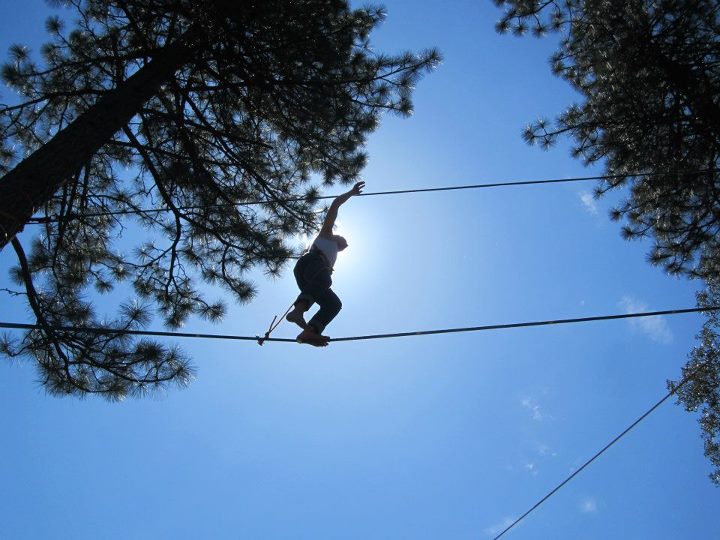
I went highlining yesterday, at Garrapata State Park, with a group of good friends of mine.

Highlining is probably the most difficult thing I’ve ever done. It’s slacklining, but really high. It involves stretching a piece of webbing between two points, and trying to walk across it. You’re secured by the leash, a piece of static rope attached to a ring which slides across the line, and you tie yourself in with a rock climbing harness. You scoot out to a safe spot, sit on the line, and then try to stand up and walk across to the other side.

(that’s me!)

In the best-case scenario, you “send” the line, making it across without falling, and maybe turn back around and walk back before untying. If you fall, you’ll flip through the empty air before the leash catches you. At the bottom, after you’re done swinging around and you’ve gotten your bearings back, you need to pull yourself back up the rope to get back to the line. Sticking a foot high up on the leash for leverage, you pull your body back up to the line with your hands. This is all upper-body strength. From there, it’s a simple matter of hooking the line behind your knees, hanging upside down, and swinging back on top, only to reach the sitting position you started in and try it all over again.

We rigged over the beach, between two wavy sandstone cliffs, looping the anchors around a chossy boulder and a small spire. The rock is awesome; different strengths of sandstone have eroded differently. Some rock juts out in jagged orange outcroppings, and other boulders are pockmarked with small bowls; the wind has eroded away so much it looks almost like they wear a wrinkly skin of softer sandstone. I had high hopes for the day! The weather and the setting were perfect. I went to sleep early, I had been meditating every day, hadn’t done anything bad to my body; I woke up early, ate enough food. I was totally on top of my game… minus slacklining. I tied in and I fell, over and over again.

The biggest benefit of highlining is simply willpower. When you’re just starting, you will fall—a lot. It’s even fun to take your first whipper, because the sheer prospect of walking on a stretchy, swingy, bouncy line 30 or 50 or 100 feet off the ground is terrifying. Your body thinks that, if you fall, you will die. It’s relieving to get over that initial fear; it’s good to know that falling off is OK. The first fall is an accomplishment in and of itself. Up on the line you feel so precarious that any action is a triumph. You’ve conquered fear and paralysis.

The next step is perseverance. You fall, and you get back on. If you don’t want to haul yourself back up the rope all the way from the bottom, you can try to “catch” the line by either grabbing it with your hands or hooking it behind your knee. But the line is hard, pulled taught with hundreds or thousands of pounds of tension, and it will transfer a lot of force to your body very quickly. The line doles out bruises, cuts, abrasions, calluses. “You just fell,” your body says. “Why do you want to go through all that effort to fall again?” After pulling yourself to a stable, comfortable sitting position, trying it all over is the last thing you want to do. It takes a lot of guts to get back to your feet.

But that’s where the good comes in. If you can manage to start walking, if you can cast doubt and pain and everything else aside, then you will find yourself in a magical place. Unfortunately, I didn’t get there. I’ve been highlining three times; the other two were at a backyard highline festival, in Garden Valley, where slacklines were strung through the trees like telephone wires. If there’s a reason why my performance didn’t match up to my expectations (in the SSBM community we call this a “john”), it would be that I was out of practice. At the festival there were slacklines everywhere, and I was all over them, starting, walking, balancing, correcting, turning around. Yesterday I never really got to the point of walking; it was all I could do to stand up and catch my balance.

The second time I got on, later in the afternoon, I was determined. This would be my last chance. Even though Blake had added more tension, making it more to my liking, I fell, again and again. I caught the line and then threw my legs back up vigorously, hanging from my knees and fingertips. My technique was off when I spun back upright—if you do it right it’s more about finesse than force—but I tried with every fiber of my heart to hold on and press myself back up. Slackliners walk a fine line between trying hard and surrendering. You need to be calm enough to notice the sway of the line, exert enough force to correct it (but not make the wobbles worse), and be tenacious enough to keep yourself on. What’s more, your body imposes a physical limit; you can only pull yourself back up a finite amount of times before you need to get off, eat some food, drink water, and recharge. After your last fall, sitting in your harness defeated under the line, you still have to pull back up, haul yourself back to either side, and climb back up onto solid ground before you untie.

So I had to call it quits. Even though I had lots of determination left, lots of fire, I knew that nothing good would come of pushing past my limits. I painstakingly hooked heel after heel and dragged myself back to the starting spire, climbed back up to safety, and untied. I was so mad. I didn’t even walk.

I laid down on a rock to collect myself. What happened? I went through all the mental checks: I was relatively Zen’d out. I had meditated that day, and every day for a week. I was connected with my body. My thoughts weren’t racing, and I had enough willpower to try and to fall a shitload of times. As I calmed down, my anger gave way to confusion. Could I have done anything better? Did anything go necessarily “wrong”? I guess I was just out of practice, and 30 feet above the ground is a hell of a place to remember how to do something. What did I learn from today? What does this mean? Why do I do this to myself?

When I last went home, me and my friends classified each other as either earth, wind, water, or fire element. I was elated to get the “fire” label. I was feeling particularly fiery that week. I was happy to be home, back with my friends. I was lifting weights and radiating heat. Sometimes I picture my will as an inner fire, and when I’m excited it ignites my whole body, spreading energy outwards from my diaphragm. I think this willpower is what Brendan and Steven and Derek saw when they called me a fire type. Later, during a phone call, my friend Adam said he always pictured me as a wind type, riding the wind and soaring when a strong motivator comes my way, or coming to a dead stop when the breeze lets up, and flying off in a different direction the when another impulse compels me. I like them both, to be honest.

So what do I have that doesn’t leave me, at the end of the day? After I’ve pulled myself back up and fallen, over and over and over, and I still can’t walk? I have the ability to choose, to say “Yes, I’m going again”—I have my determination. Lying down on the rock, eyes closed, I realized I still have my fire, my willpower. That will stay with me until the end, whichever way the wind decides to blow it.

Posted in All posts | Tagged , , , , , , , , , | 2 Comments

Burying vs Immersion

Whatever I’m doing, I like to immerse myself in it. Sometimes, if I’m in a particular mood, I’ll bury myself. Although they both imply focus, they’re not the same! One is like swimming around underwater, and the other is like sinking into the mud at the bottom of the lake.

Immersion is the good kind—when you’re immersed in something, you’re awestruck, enraptured; you’re learning and growing, and everything seems like wonder before your eyes. Did you know that you can do X, Y, or Z? Did you know it could make you feel so good?

Burying is the bad. I don’t want to talk to anybody. Go away, I’m doing the dishes. Technically you’re engaged in what you’re doing, but the motivation is wrong. You’re caught up in that thing because you’re trying to cover something else up: a concern, a nagging thought, a sense of unease. You’re ignoring something.

Take the following example, culled from my own life. I’m about to cook dinner. I’m chopping onions. Someone comes into the kitchen to talk to me. My responses go like “Yeah,” “OK,” or “Hmm.” My body language is off; my back is usually squarely towards the person, and I tighten up. Whether I realize or not, I’m subconsciously trying to exclude the other person. I might start a particular topic of conversation, but this is a mere cordiality.

“How was the party the other night?”

They respond.

“Oh, nice.” I don’t really care—can’t you see I’m choppin onions here?! I silently plead for them to go away, and excuse my awkwardness by devoting extra care to my stinky bulbs.

Really, the onions will get chopped just the same if I put a little extra soul into my conversation. The main difference is that, in the first scenario, I didn’t really want to talk in the first place. I pretend to be extra-involved in my cooking to cover up the tension I feel between me and a given person.

This goes the same for anything. I’m an all-or-nothing kind of guy, and I like to try my best at anything I do. Naturally, this requires a high level of attention. But when I’m buried in whatever I’m doing, there’s no room for anything (or anyone) else.

It’s easy to use action as a defense mechanism. I really like getting approval from other people, but I’m afraid of getting hurt. The solution: hide away in your pursuits. For a long time, I’ve wanted for people to look at me and infer some sense of worth based on the results of my efforts. “Wow, Joe is so cool! Look at the way he rock climbs! He’s so buff!” Or “Just look at how good that essay is!” Or “I can’t believe how fast you picked that up!” Insert any positive quality at the end of those sentences, and you have the rough idea. The core of me is still obscured. There’s just enough poking above the ground to deal with others on the surface level, but all you see is a man, some one, doing some thing.

Have you ever been buried by friends at the beach? You lie down in a ditch and they pile sand on top of you. Eventually you get sick of it. It gets hard to breathe.

If burying is selective attention mixed with shame, then immersion is focus mixed with gratitude. You’re still in whatever you’re doing, but it’s YOU, and it’s ALL you. Instead of stifling self-expression, the immersive activity becomes a means to that end. Recently, this happens when I play music, when I say what’s on my mind, when I joke with people, when I write.

The tricky part is that any one activity can play both roles; it’s not about what you’re doing, it’s about how you feel when you’re doing it. Some days are better than others. I’m in a music class right now, and it’s been a fantastic experience. Sometimes, though, I’ll walk away from the piano frustrated, tired, or fed up. It just happens sometimes. *shrug*

Everybody buries themselves to a degree—everybody! So instead of soullessly going about your duties, trudging along with a heavy heart and weary eyes, take a step back. If you don’t feel it then relax, take a few deep breaths, and ask what part of your experience you’re trying to bury. That’s what really needs your attention.

***

I’ve committed to unburying, little by little. I think the key is to go a little bit easier on yourself. The only two things I’m really trying to uphold are meditating every day and NoFap (http://www.reddit.com/r/NoFap/faq if you don’t already know). Other than that, I’m on the lookout for doing things with a defensive attitude. If your heart’s not in something extra-curricular, then don’t worry about it! Tonight my body hurts, so I decided against climbing, and I’m tired, so I decided against meeting up with a friend. Not to worry; it’ll happen in good time!

Recently I’ve felt pulled back into writing, so here’s where I’ve landed. The final practice is simply writing more! For me, communication is the center of unburying. Be on the lookout for different limbs of mine erupting from the sand at odd angles. See you all soon.

Posted in All posts, Self-Improvement | Tagged , , , , | 4 Comments

Uncorking

It feels like I have way too much pent-up energy these days. Emotions are bottled away, and I’ve gotta uncork them.

This blog in particular exists in a weird place in my mind. Everything I’ve written so far has been really formal, keeping with a particular persona. In a way, I hate this, because the high standards I’ve set for myself sometimes actually deter me from writing. These standards are obstacles, because it feels like I can only express myself under the most rigid of conditions. That sucks!

I was really disappointed earlier today, because I realized that I’m out of the practice of writing. Emotional transparency is my goal; writing helps me see what’s important to me. It’s dredging. It’s weird to think that this process, which has been so important to me in the past, is now reserved for a few formalized occasions, each with their own set of pretensions—writing essays (about things I usually don’t care about), new blog posts (which I probably care too much about), and journalling (which falls into the same patterns I’ve developed over the course of, say, ten years). My voice finds outlet only in these things, and the rest of the time it’s just trapped in my head. As a result I’ve been bottled up; it’s hard for me to say what I really mean, and it’s hard to do what I really want to do.

So in the future expect more updates, with a less formal tone, as I do some uncorking.

Posted in All posts | Tagged | Leave a comment

Long time no see

Hey everybody.

I’ve been timid, and for that I apologize. Change is the scariest thing in the world; sometime around the turn of the new year, I felt myself changing, and I got scared. So I stopped writing, talking to new people, and confronting the things which frighten me. I ceased growing.

The process of taking up new hobbies–things which scared me, shook me, and brought me face-to-face with failure–was enough to break the daily melancholy, but only temporarily. Soon enough, everything got stale again. My newfound outdoor hobbies–rock climbing, slacklining, camping–weren’t doing the trick anymore. Due to the simple fact of momentum, I continued to improve in what were now my areas of comfort, but it wasn’t enough. I came to them the same way as I do with computer, with videogames; needily, anxiously, routinely. Compulsively. They took me over, and I subjugated myself to their pursuit.

I was dismayed to find out that I couldn’t land on the right feeling simply by doing a correct set of things. The human being is too complex; we can’t follow a set of other people’s rules and expect satisfaction. There’s no proverb big enough to fit the whole of you. No advice column stands a chance.

During a bout of crippling indifference, I found myself wondering: “What’s left?” What was there to cling on to, what could I do that would make me feel… alive? I knew what had worked in the past, or things I could have started on, yet I kept asking, like a petulant child, “But why?” Would I, in fact, be better off having these things done? If my previous efforts failed, why should anything else work? What’s the point? It wasn’t until I spent a weekend at a smash tournament–a scene which I’ve been following for roughly four years, and which is the absolute epitome of my comfort zone–wandering around dazed, stoned, or tired the whole time, that I realized the worst thing of all would be the dominance of this melancholy for the whole of my life. Where was I, underneath all those appearances? Under all those half-thoughts, “whatever”s, “oh well”s, yawns, and grumbles? In my worst lulls, the spark of my existence goes from dim to sputtering out. The worst fate of all isn’t death, it’s perpetual dormancy.

What’s there to get excited about? Where’s my life force at? What’s worth living for?! I can’t say I know for certain. What gets me going–what turns me on? I know it once I have it, once I’m in it, but there are no commandments. Nothing’s written in stone; it changes too fast. By the very nature of the thing, it’s whatever presently lies right out of grasp–that which is tantalizingly close, but incredibly far away, for its achievement (or even an attempt at it) lies over the hurdle of the hardest thing you’ve ever done before.

I’m chasing myself down. The process of acting out my impulses, and instantiating them in my reality, is terrifying to me, but its necessary. I’m trying to be goofier, more emotional, more aligned–more palpably Joe. Over all these years, I’ve hid myself away for fear of rejection, failure, change, success, or I don’t know what. Maybe it’s just what I’m used to doing. I have to tease me out of myself; I want to feel the risk of failure in my chest and stomach, because that’s the feeling of progress. True motivation lies deep inside, I think, and sometimes you have to jackhammer it out.

If I know anything right now, it’s that doing the right things, repeatedly, will bring the new, the frightening, the glorious, the triumphant into my life. If I target the things that are important to me, and give them my best effort, I have faith that I will become a better person–I will become more “me.”

With the help of a friend, I shaved my head into a mohawk yesterday, which I have never done. It’s pretty uncharacteristic of me, but I wanted to do it, so I did. Sticking to your guns is the hardest thing in the world. The hardest part of writing anything, especially online, is not thinking: “Fuck it, this sucks,” deleting the whole thing, and resigning yourself to the hopeful belief that your half-articulation, half-cowardice, half-effort has somehow made you better. That’s a cop-out, though. You’ve looked failure in the face for a split second and gone running off with your tail between your legs. So, here’s this post–chock full of self-doubt, setting forth a shaky, insecure mission statement, miles from my ideal expectations. It’s progress.

Since I know y’all are curious:

Posted in All posts, Self-Improvement | Tagged , , , , , , , , | 8 Comments

My Furiously Beating Heart

My furiously beating heart pumps blood like punches as I lie and try to sleep.

I can’t succumb to what I’m not;
it demands to take hold of this moment like a prisoner.

The pressure of each beat is a message I can’t deny,
an undisputable signal sent from places deep inside.

One day we’ll merge, and thoughts of
this, that, he, she, her, and mine
will cease to be, and I will flow through the canals of my own veins
as life inconquerable, undeniable.

No longer will I lie in darkness, eyes shut tight against the presence of the world,
feeling the intermittent pressure of each second—
my adamantly beating heart.

Posted in All posts, Fiction/Creative | Tagged , , , , | Leave a comment

Words of Encouragement

hey everybody

I just wanted to say that I love you all. Each of you is beautiful, amazing, funny, awesome, and the world would be much worse if you weren’t around.

Don’t do shitty, stupid things to yourself, because you deserve the best, and you deserve to do the best you can to yourself. You’re worth it. You’re the best.

I want every single person I know in my life to never sell their self short, never settle for something they know isn’t the best for them, never think that at the end of the day they aren’t important, talented, special, unique.

Even if you don’t believe in yourself temporarily, don’t let it get to you. Even if it seems like the whole world is against you, know that it’s not. When it feels like you don’t have anyone in your corner, know that there’s at least one person there: me.

Life is amazing, and YOU are amazing. Don’t fucking let anything get to you, because god damn it, you are SO important to me. Nothing is worth hurting yourself over.

Sometimes I feel like I’m too far removed from the people I love, like I can’t do anything to help them or I can’t sway them from their bad decisions no matter what I do. If I can have ANY impact at all on the wonderful people I have in my life, I want it to be this. You are incredible; as long as you live, don’t forget that.

Posted in All posts, Self-Improvement | Tagged , | 2 Comments

Note to Self

I took some time out yesterday to make this reminder for myself, and it lives on my computer desk now.

If you’ve been thinking about something, forget about any distractions and just do it. It’s really that simple. If it’s been on your mind, it’s probably important. Nine times out of ten you’ll look back and think “Boy, I feel much better with that out of the way.”

There’s a lot you can accomplish better without thinking, big things and little things. For me, the challenge is avoiding distractions and just plain doing the important stuff. I know what matters to me; it’s just to do it. What are some things that have been on your mind, and why haven’t you done them yet?

Posted in All posts, Self-Improvement | Tagged , , , , , , , | 1 Comment

Bits and Pieces

When you first meet someone, it’s only a glance. You fall in love with a sidelong gaze, a vague peripheral impression, fleeting eyes on the bus. Your first idea of someone is a disconnected image which floats around in your brain, and you look back now and then to make sure you got it right. Later, you notice smaller details. She looks away and you study her, taking in the structure of her face, the color of her eyes, freckles around her nose, which may jut or slope out at this particular place, with these such proportions. You watch her hair move, catch the light and hold it. Still later, there comes excitement from acknowledging each other. In small moments you make eye contact—you see her smile and you smile too. Why not? Your eye moves to her cheek, her shoulder, and then flits away to another object. During brief secretive moments, you check out the rest of each other’s bodies.

Gradually, you will come to know her body almost as well as you know yours. You are introduced; you familiarize. The shape of her eyes as she smiles, laughs, or frowns is embedded in your memory. While manipulating a shared object, you learn her hands, plotting freckles, hairs, and scars like points on a map. As you uncover her personality in phases, so do you uncover her body. You see her in less and less clothing, noting the curves of her stomach, hips, and legs. You append toes, arches, and ankles to your image of her, dropping her on top like an action figure on a pedestal. You make each other laugh. You spend more time together, and if the process of intimation continues, love is declared. She is the most important thing in your life, and if she can be trusted, you are the most important thing in hers. You consummate the relationship with sex, and in one moment of sweetness you acquire her, adding her body to your own. Now you may study it intimately, revere and examine it with a mute curiosity. It is yours now, just as your body is hers.

At various times, you zoom in closer and closer, discovering more. What are the shape and color of her teeth as they click together in her jaw? Which color is the back of her throat and tongue, compared to yours? How does her hair fall when it gets oily and dirty; what rivulets of scalp show through? What does her breath smell like at different times of the day? If she is tired, how does the skin around her eyes change? Does she have moles in private places? Is she fat?

For the most part, you have charted her body out as thoroughly as your own. Yet ultimately, this knowledge will never match the understanding of the self. Your empathy is insufficient. You are intimate, but not unified—you are separate. You can observe her pain, or share simultaneous pleasure, but you may never feel her body as your own.

Where there is a lack in sensory understanding, I seek to gain a vast analytical understanding. Maybe if you found out enough, you could put yourself in her shoes. Be thorough: What is the shape of every tooth in her head? What ridges cross her incisors? Find an equation that would plot it in a three-dimensional graph. You are now one step closer to discovering what it would feel like to run her tongue across her teeth, chew on a bite of hot dog and swallow. What angles do her teeth fit together at? Have you gotten them all?

Begin by performing a thorough visual analysis. It wouldn’t hurt to draw each part of her in detail. . . repeatedly. Study her genitals. How does the configuration of skin and membrane affect the sexual experience? Each fold, when stimulated, fires off a different set of frenzied neurons to the brain. Can you imagine switching places during sex? Continue by characterizing every hair on her body—break her down like an engine. Trace the veins and muscle fibers through her skin; note her bone structure and postulate models of her anatomy. Could you build her from the ground up? Given all the technology of God, could you assemble her from scratch? Poke around in her guts; posit the path of her intestines, and watch her stomach bloat and deflate depending on the rhythms of digestion. Watch individual droplets of oil pool on the microfissures of her face, and run together like so many streams.

Watch each atom of air dive into her beautiful lungs and be respired. Watch the chemical reactions of carbon, hydrogen, and nitrogen take place—watch her breathe, live, and grow older second by second.

Do you now know her?

* * *

I used to want to climb the whole world. If time were to stop on a dime, for eternity, I would learn how to climb up anything and everything. I’d start small—the big oak tree at the park, the mountains outside of the city, the stones cemented in the side of the local library. I would climb on top of every roof in town. Later would come harder things: shimmying up between flat wooden walls, crimping tiny ledges to flip on top of awnings, maneuvering like a spider around the inside corners of ornately decorated banks. Pull-ups and foot-jams. Toe hooks, heel hooks, body props—pressing, pushing, struggling, I’d ascend. Palm trees and marble pillars. Cliffs, boulders, and cracks. Kilimanjaro, Whitney, Everest. If I had eternity, my conquest would simply be a matter of time. I would travel the country looking for new objects to scale and conquer: skyscrapers, city halls and town-homes; large animals like elephants, giraffes and rhinoceri. I would know all these objects by experience—I would have mastered them. I would come to know the whole world—it would be mine.

After climbing everything reasonably possible, I would downsize. I’d shrink myself, maybe at first to one-quarter size. I would revisit my prior triumphs and be forced to find new solutions. Each reach would be further, each minuscule hold would become necessary. The handicap would be exciting, offering new challenges. After inevitably repeating my conquest (after all, we’re talking all eternity here), I would shrink to one-eighth size, one-sixteenth size, one-thirtysecond. I’d invent new routes, starting at home: the paint of my bathroom wall, once detailed but unremarkable, would be an effective El Capitan. Thousands of hidden routes would spiral up my sink, shower and toilet. I could practice on every fiber of my shag carpet. The stucco of all my neighbors’ houses would offer immeasurable depth. It’s a matter of scale and perspective; when I had previously climbed Mt.Rushmore, I would climb up the cracks in the skin of my lover’s inert face, maneuvering in and around pores and stopping for rest on errant hairs. At, say, one quarter of a millimeter tall, every texture in the world would be a varied, intricate climb.

As I shrank further down into minuscule sizes edging nonexistence, the challenge would become impossibly large, and I would know infinity. I would struggle up everything you can see or touch. Everything. Perhaps I would scale the sides of the smoothest metal sphere ever made by science. I would look for climbs like rock climbers size up boulders in the nooks of interesting molecules, the nuances of nuclei in individual atoms. After examining, learning, and summiting every particle on the physical plane, I would finally shrink down to the size of the smallest matter in existence, and thus merge with the universe at large, knowing that there was nothing else in all creation to learn or conquer, and that my purpose had been fulfilled.

I used to want to do this, but I don’t like the idea anymore. How sad it is to think that the world is finite and conquerable! How selfish! to think that this thing we call “I” could master all of the universe, the tangible and that which we have only speculated on, by dividing life into processes, projects, goals.

Is it possible to know love through analysis? If you knew enough about your lover to infer the sensation of kissing you on the lips, pressing her breasts and body close to yours, would that be the same as feeling it? Just as you can’t bridge the emotional gap of perspectival distance with knowledge, you can’t learn the purpose of the universe, the meaning of an atom, a boulder, or your life, by simply attempting to master it.

Detachedness precludes happiness, no matter how thorough you are. Be where you are, feel where you are going, and know that when you look into her eyes, you gain a worth and understanding that transcends an eternity of isolated study. Know yourself as you know her. Feel your life—this is it.

Posted in All posts, Fiction/Creative, great | Tagged , , , , , | 1 Comment

Folds

I want to swallow you up
like a pelican

encase you in the warm folds of my neck

and, stretching, yield to all your struggles

until you
stop

moving.


This was a poem I wrote at the beginning of summer, and I decided to put it up because I love the mental image. More posts coming soon.

Posted in All posts, Fiction/Creative | Tagged , , | Leave a comment

Say more with less.

Posted in All posts | Leave a comment

One-Day Fiction: Part 1

My sister is wise beyond her years. She challenged me to write a short story in one day and post it ASAP. The goal of this exercise was to get used to writing and not worrying about the result. Overall I’m really happy with what I wrote. I present to you the first part of a short story, minimally edited. I’ll write the rest of it in the same vein, with the goal of becoming comfortable with the writing process in mind.


She fell in love with his jacket. It had rained for a week straight, and the fog hung heavy over trees, cement bluffs, dorm buildings. The wet crept into the stucco, slicked cement staircases, and soaked into redwood bark. The campus was inundated. Bodies of all shapes and sizes bundled up; students put on heavy socks, sinched up bootlaces, and pulled on sweaters. They walked around wrapped in cocoons of comfort and insulation.

Elise saw him, for the first real time, when the rain abated and the sun shone through the white sheet of fog, breaking the uniform whiteness of the overcast sky. For a second, the fog broke and the sun’s diffuse rays focused in on this boy. He wasn’t particularly tall; he wore a heavy, navy-blue sweatshirt. His shoes were clean and his jeans were unwrinkled. His hair seemed like it had always been tame, and he wore a look of perfect comfort on his fleshy face. She stumbled for a moment, as he lit up, and watched him walk detachedly by.

Elise was a small girl, full-figured but short. Her sideswept blonde hair framed high cheekbones, full lips, a slim nose and strong chin. She was pretty, but only on close inspection. Every Monday, Wednesday, and Friday, it rained, and she saw the jacket walk by, zipped up, hood up, barely outlining the body underneath. It revealed maddeningly few details of physique, definition, or symmetry. Every other weekday she saw his auburn eyes glide by half-closed. They moved once or twice, but never fast enough to break the beguiled expression on his lips, or crack his casual composure. And never to meet her. She knew the route he took to class, but he was imperturbable. She saw him walking again and again, and knew what she had to do.

The premeditated day, a drizzle had slicked the earth since sunrise. Elise picked out her clothes: a loose tanktop, a bright red zipup hoodie, the right bra. She would catch his attention. She left for her first class, stopped off at the bathroom, and calculated the exact spot the zipper should rest at. It was a careful equation of modesty, aerodynamics, and lift. She shrugged and bounced, one last check, then walked outisde.

The mist came down heavy. As Elise walked on, she felt it settle down on her face, felt it peppering her cleavage until her breasts slid past each other frictionless when she twisted around. The tips of her straw hair hung down around her collarbones in wet tendrils. He came walking from the other side of the clearing, hands jammed in pockets, hood up. The rain softly increased. She studied his countenance—their eyes danced—he recognized her, she noted his recognition, and the inevitable pull of casual pace drew them closer and closer together. Her gaze took inventory of a tree as he entered the interpersonal zone; she gave permission. The distance closed with each step. At the climax of the encounter, a quarter second before the two parties pass out of each other’s attention and out of their life, she looked back. The boy’s eyes caught her cheekbone, glanced off her shoulder. They opened in a brief moment of fear; he was caught. He dropped like a stone to her cleavage, attracted magnetically to her slick bosom held aloft. As they crossed, she smiled wryly. It flashed onto her face like a lightswitch. Then they were out of sight, gone. He had looked—it was just a look, but it was enough.

Posted in All posts, Fiction/Creative | Tagged , , , , , , , | 5 Comments

Fiction Challenge

I had a really long talk with my sister tonight, and she has challenged me to write a piece of short fiction and publish it before the first day of classes (this coming Thursday).

The time constraint will make this task challenging, but I think it’s a good opportunity to broaden my horizons and kill some of the perfectionism in my writing. Call it writing outside of the box; stepping outside of your comfort zone is crucial to learning, and this is exactly what I want to try.

So, expect a short story of some sort by Thursday!

Posted in All posts | Leave a comment

Loving Your Life and Cherishing Others

About a week ago, I got an email from my uncle. I read it in the morning, and I cried. I read it again that night, and I cried again. Two hours later, I set up this website.

To know how this experience affected me, it makes sense to know a little bit about me. I’m a competitive individual. I set high standards for myself, and when I get into something I go all out. Lots of my time is dedicated to improvement in rock climbing, videogames, writing and understanding myself. I’ve learned a lot, but sometimes I wonder: where am I, behind all that practice?

I woke up on Monday morning, three days after finishing classes, plagued with doubt. I turned on my computer, and in one of hundreds of empty routines checked my email.

My uncle Mike was diagnosed with MDS about a month ago, otherwise known as pre-leukemia. Patients develop blood conditions due to broken bone marrow. My uncle started chemotherapy, and will require a marrow transplant later on. The bright news is that MDS usually occurs in the elderly. Since my uncle is younger, there’s a good chance it won’t develop into leukemia. Also, since he’s one of five children, there was a good chance of finding a marrow match within the family.

For whatever reason, his diagnosis didn’t initially have a huge impact on me. My father described the news in a clinical fashion, using that serious tone reserved for family members. I shrugged it off with nonthinking optimism. This could have been simple immaturity on my part, a lack of empathy brought on by a defense mechanism that held things at arm’s length. I’ve had bad things happen in my life; I regarded them with distance and skepticism. Why dwell on them, right?

The email hit home. As I drank coffee and listened to obscure music, I read about his battle with a life-threatening disease; the tedium of treatment, long hours in hospitals and exhausting blood transfusions. And more bad news: none of his siblings turned out to be a match. Yet the whole time he kept a positive, realistic perspective. “A twisted journey, but one to be faced head-on one day at a time!” His wife has been there at every turn, his neighbors brought over “food for days” and did hours of yardwork, out of the kindness of their hearts. How can I help out? His suggestion: pay it forward by donating blood and registering for marrow donation.

And here’s the part that made me cry. He signed it:

Now, the English lit major in me quickly noted that the parallel structure in that phrase is off. It’s got the alliteration down, but life is a noun, laugh is a verb, and love can be either depending on how you use it. For all its imperfections, this peculiar message shone all the brighter. When he signed his name in that enormous blue font, he staked a claim—his struggle, his feelings, his words. Mike. It dawned on me; my uncle knows this as an opportunity. By staying positive, he can isolate and focus on the important things in life. “Love is Grand!” he wrote.

Later that night, things started fitting together. As I finished reading for the second time, seeing again the three assonant words in mock parallel structure, I felt chills shoot up my spine. My head tingled, my throat tightened; my eyes swam, my arms and fingertips warmed with blood. Life, laugh, love. All daily, petty concerns evaporated, and the fog of my ego vanished. This was what I was searching for, this whole time. These three things. This feeling.

I felt the rush of an epiphany. In the end, it’s just not about me. Every thought made tears ferment behind my eyes. Every choked convulsion of my diaphragm brought breath into my body, which radiated outward as limitless energy. Love. It felt like a spotlight had been shone on my life, and I saw a dazzling landscape of possibility. Everything was utterly clear.

Looking back on this experience, I started analyzing. A patient is diagnosed with a life-threatening or terminal disease, and he or she spends the next couple of months connecting with loved ones, cherishing every moment. Why is this familiar narrative so powerful? Above all else, in stories like these we see a choice. The conscious choice to remain positive, in the face of the most adverse conditions, is a testament to the character of the human spirit. It’s liberating to think that, under all the games, noise, and appearances which make up our daily life, human beings are fundamentally focused on caring for one another. It takes a wise man to see this, and a stronger man to live it.

I’ve learned that you don’t need to analyze life to enjoy it. For analytical people like myself, it can help, but only when used in moderation. Judge people by their actions; words, intentions, and conjecture about the future are largely worthless. Personally, I get too fixated on self-improvement. When I don’t see the results I want, when it becomes clear that my actions don’t line up with my intentions, then doubt permeates my life, and I drown in uncertainty and hesitation. In short, I over-analyze. But this email made me step outside myself—after all, what is all my work for? All the journaling, all the analysis in the world can’t give you the experience of feeling love. An individual is only as great as the joy he can bring into the lives of others. My purpose in starting this blog is to affect as many people as possible, and hopefully change their lives for the better.

In my eyes, every real action contains work, and every action is a product of choice. Because of his condition, my uncle Mike works every day with the whole force of his being. He chooses to celebrate life, and cherishes the support of his wife and loved ones. Every day, he embraces the ever-present love which makes us who we are. Passing on his message to others is my choice and my work. This is why I started this blog, and this is my message to you.

My uncle Mike is a quirky man. He’s not perfect—he doesn’t make millions, and his English is certainly critiquable—but that’s why his actions send such a powerful message. It doesn’t take a saint to be an example and an inspiration. It took me awhile to figure out why, but “Life, Laugh, Love” broke me down so bad because it was completely genuine. It’s a phrase that’s rough around the edges, quirky and overflowing with charm just like my uncle. This is my blog, and I am a literary kind of guy, so I was debating over changing it to match as three verbs. I think I’ll leave it, though. So live, laugh, and love—whatever way you can.

Posted in All posts, Self-Improvement | Tagged , , , , , , , | 5 Comments

First Post

Hey everybody, this is my first post. You’re reading it. Welcome.

My name’s Joe, I’m a student at UC Santa Cruz, and I just turned 21. I’m really excited about a lot of things, and I feel like I have a very unique perspective. I have a really strong urge to get my opinions out there, polish my writing voice, and sort out and improve my own life.

Expect various posts about philosophy, games, social life, and self-improvement. For now I’m learning how to work wordpress, so bear with me for a bit. In the meantime, I’ll link to a few things that inspire me so every reader can get a better feel of what’s to come.

Cheers!

Posted in All posts | 2 Comments